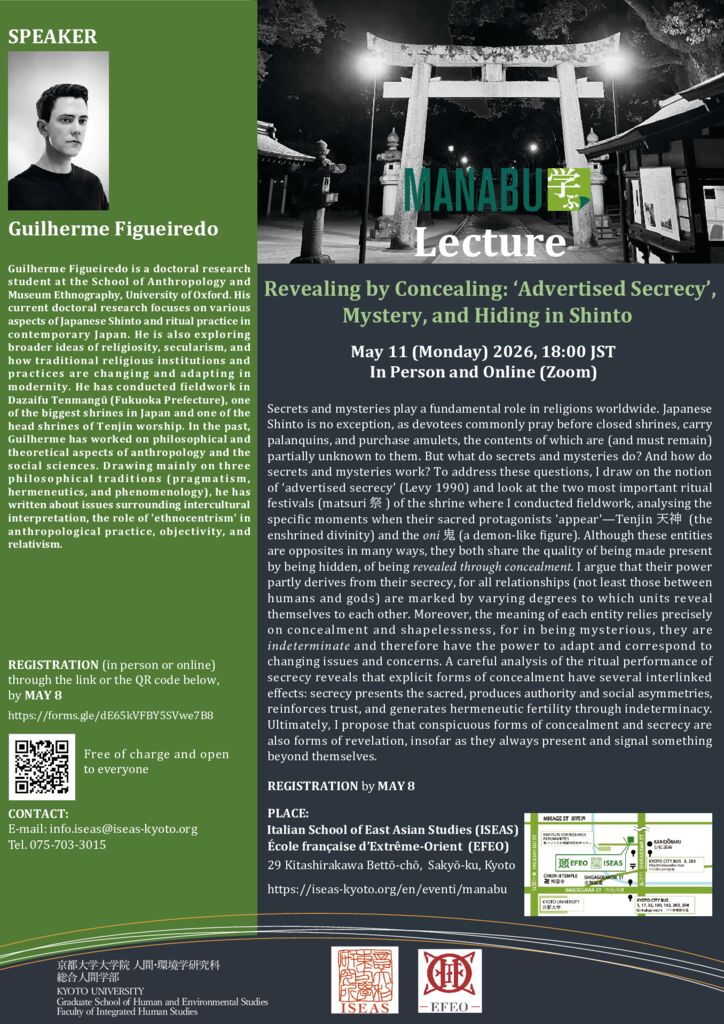
Secrets and mysteries play a fundamental role in religions worldwide. Japanese Shinto is no exception, as devotees commonly pray before closed shrines, carry palanquins, and purchase amulets, the contents of which are (and must remain) partially unknown to them. But what do secrets and mysteries do? And how do secrets and mysteries work? To address these questions, I draw on the notion of ‘advertised secrecy’ (Levy 1990) and look at the two most important ritual festivals (matsuri 祭) of the shrine where I conducted fieldwork, analysing the specific moments when their sacred protagonists ‘appear’—Tenjin 天神 (the enshrined divinity) and the oni 鬼 (a demon-like figure). Although these entities are opposites in many ways, they both share the quality of being made present by being hidden, of being revealed through concealment. I argue that their power partly derives from their secrecy, for all relationships (not least those between humans and gods) are marked by varying degrees to which units reveal themselves to each other. Moreover, the meaning of each entity relies precisely on concealment and shapelessness, for in being mysterious, they are indeterminate and therefore have the power to adapt and correspond to changing issues and concerns. A careful analysis of the ritual performance of secrecy reveals that explicit forms of concealment have several interlinked effects: secrecy presents the sacred, produces authority and social asymmetries, reinforces trust, and generates hermeneutic fertility through indeterminacy. Ultimately, I propose that conspicuous forms of concealment and secrecy are also forms of revelation, insofar as they always present and signal something beyond themselves.
Guilherme Figueiredo is a doctoral research student at the School of Anthropology and Museum Ethnography, University of Oxford. His current doctoral research focuses on various aspects of Japanese Shinto and ritual practice in contemporary Japan. He is also exploring broader ideas of religiosity, secularism, and how traditional religious institutions and practices are changing and adapting in modernity. He has conducted fieldwork in Dazaifu Tenmangū (Fukuoka Prefecture), one of the biggest shrines in Japan and one of the head shrines of Tenjin worship. In the past, Guilherme has worked on philosophical and theoretical aspects of anthropology and the social sciences. Drawing mainly on three philosophical traditions (pragmatism, hermeneutics, and phenomenology), he has written about issues surrounding intercultural interpretation, the role of ‘ethnocentrism’ in anthropological practice, objectivity, and relativism.
This hybrid lecture will be held on site and via Zoom.
Registration required in advance from here by May 8.