Manabu
Revealing by Concealing
‘Advertised Secrecy’, Mystery, and Hiding in Shinto
Guilherme Figueiredo
11 maggio 2026 18:00
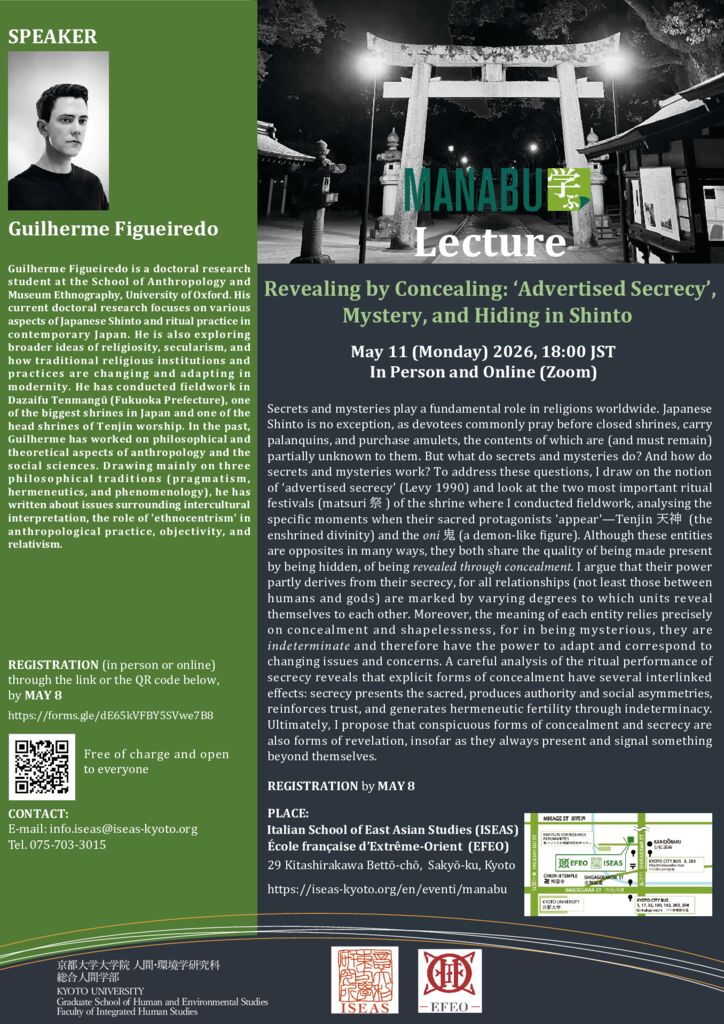
Secrets and mysteries play a fundamental role in religions worldwide. Japanese Shinto is no exception, as devotees commonly pray before closed shrines, carry palanquins, and purchase amulets, the contents of which are (and must remain) partially unknown to them. But what do secrets and mysteries do? And how do secrets and mysteries work? To address these questions, I draw on the notion of ‘advertised secrecy’ (Levy 1990) and look at the two most important ritual festivals (matsuri 祭) of the shrine where I conducted fieldwork, analysing the specific moments when their sacred protagonists ‘appear’—Tenjin 天神 (the enshrined divinity) and the oni 鬼 (a demon-like figure). Although these entities are opposites in many ways, they both share the quality of being made present by being hidden, of being revealed through concealment. I argue that their power partly derives from their secrecy, for all relationships (not least those between humans and gods) are marked by varying degrees to which units reveal themselves to each other. Moreover, the meaning of each entity relies precisely on concealment and shapelessness, for in being mysterious, they are indeterminate and therefore have the power to adapt and correspond to changing issues and concerns. A careful analysis of the ritual performance of secrecy reveals that explicit forms of concealment have several interlinked effects: secrecy presents the sacred, produces authority and social asymmetries, reinforces trust, and generates hermeneutic fertility through indeterminacy. Ultimately, I propose that conspicuous forms of concealment and secrecy are also forms of revelation, insofar as they always present and signal something beyond themselves.
Guilherme Figueiredo is a doctoral research student at the School of Anthropology and Museum Ethnography, University of Oxford. His current doctoral research focuses on various aspects of Japanese Shinto and ritual practice in contemporary Japan. He is also exploring broader ideas of religiosity, secularism, and how traditional religious institutions and practices are changing and adapting in modernity. He has conducted fieldwork in Dazaifu Tenmangū (Fukuoka Prefecture), one of the biggest shrines in Japan and one of the head shrines of Tenjin worship. In the past, Guilherme has worked on philosophical and theoretical aspects of anthropology and the social sciences. Drawing mainly on three philosophical traditions (pragmatism, hermeneutics, and phenomenology), he has written about issues surrounding intercultural interpretation, the role of ‘ethnocentrism’ in anthropological practice, objectivity, and relativism.
This hybrid lecture will be held on site and via Zoom.
Registration required in advance from here by May 8.
Manabu
Parallel Histories, Plural Interpretations
Language, Translation and Interpretation at Asia-Pacific War Heritage Sites
Oliver Moxham
4 luglio 2024 18:00
This lecture will be held on site and via Zoom
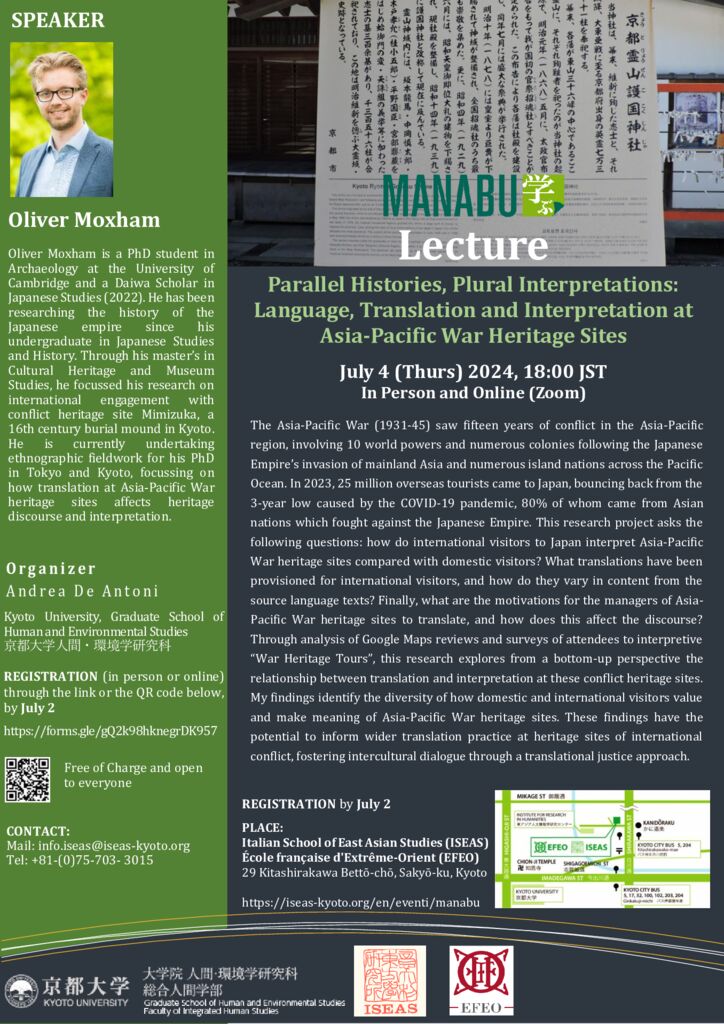
The Asia-Pacific War (1931-45) saw fifteen years of conflict in the Asia-Pacific region, involving 10 world powers and numerous colonies following the Japanese Empire’s invasion of mainland Asia and numerous island nations across the Pacific Ocean. In 2023, 25 million overseas tourists came to Japan, bouncing back from the 3-year low caused by the COVID-19 pandemic, 80% of whom came from Asian nations which fought against the Japanese Empire. This research project asks the following questions: how do international visitors to Japan interpret Asia-Pacific War heritage sites compared with domestic visitors? What translations have been provisioned for international visitors, and how do they vary in content from the source language texts? Finally, what are the motivations for the managers of Asia-Pacific War heritage sites to translate, and how does this affect the discourse? Through analysis of Google Maps reviews and surveys of attendees to interpretive “War Heritage Tours”, this research explores from a bottom-up perspective the relationship between translation and interpretation at these conflict heritage sites. My findings identify the diversity of how domestic and international visitors value and make meaning of Asia-Pacific War heritage sites. These findings have the potential to inform wider translation practice at heritage sites of international conflict, fostering intercultural dialogue through a translational justice approach.
Oliver Moxham is a PhD student in Archaeology at the University of Cambridge and a Daiwa Scholar in Japanese Studies (2022). He has been researching the history of the Japanese empire since his undergraduate in Japanese Studies and History. Through his master’s in Cultural Heritage and Museum Studies, he focussed his research on international engagement with conflict heritage site Mimizuka, a 16th century burial mound in Kyoto. He is currently undertaking ethnographic fieldwork for his PhD in Tokyo and Kyoto, focussing on how translation at Asia-Pacific War heritage sites affects heritage discourse and interpretation.
Prior registration, on-site or online, is required from here by July 2.
Manabu
Manabu XIII
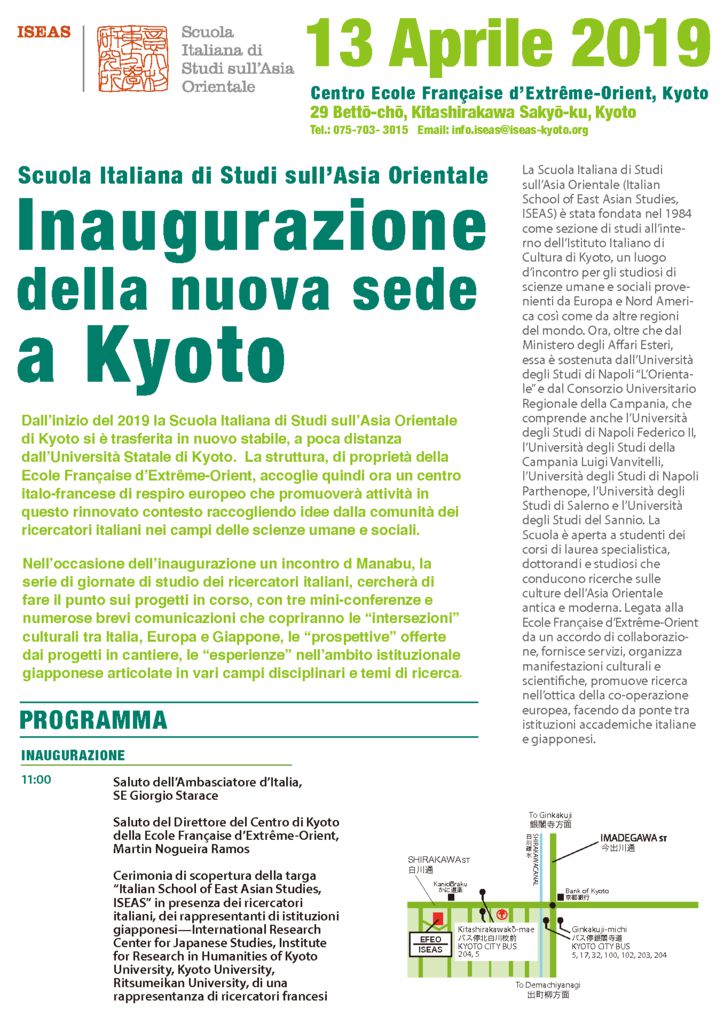
Inaugurazione della nuova sede a Kyoto
13 aprile 2019 11:00 - 18:00
Scuola Italiana di Studi sull’Asia Orientale, Kyoto
Manabu
Manabu XII
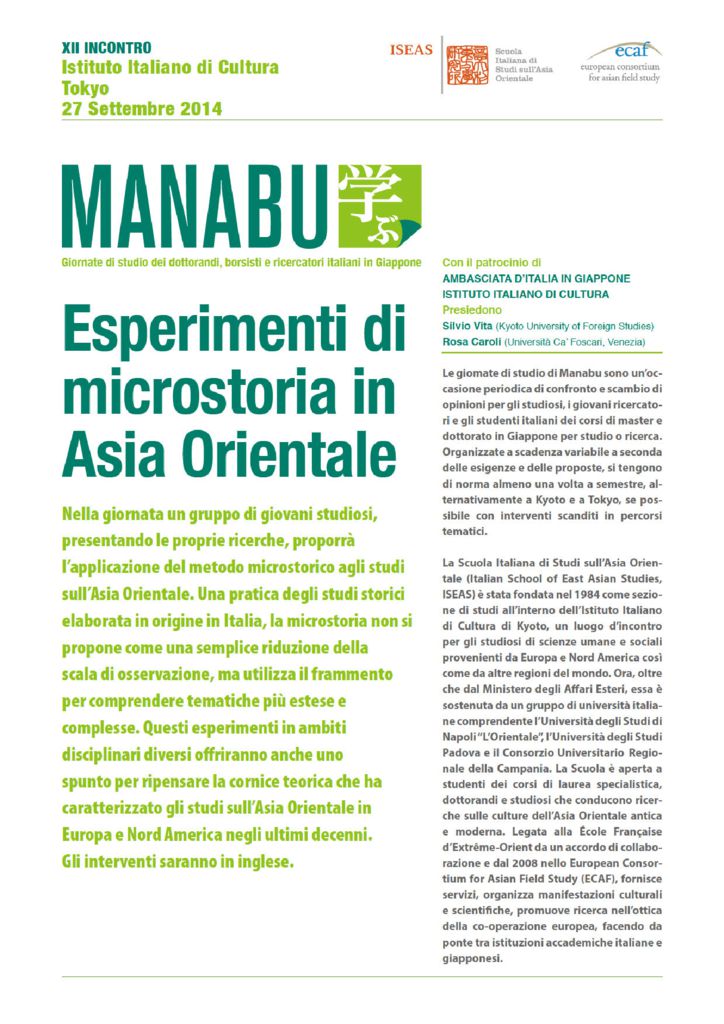
Esperimenti di microstoria in Asia Orientale
27 settembre 2014
Istituto Italiano di Cultura, Tokyo
Manabu
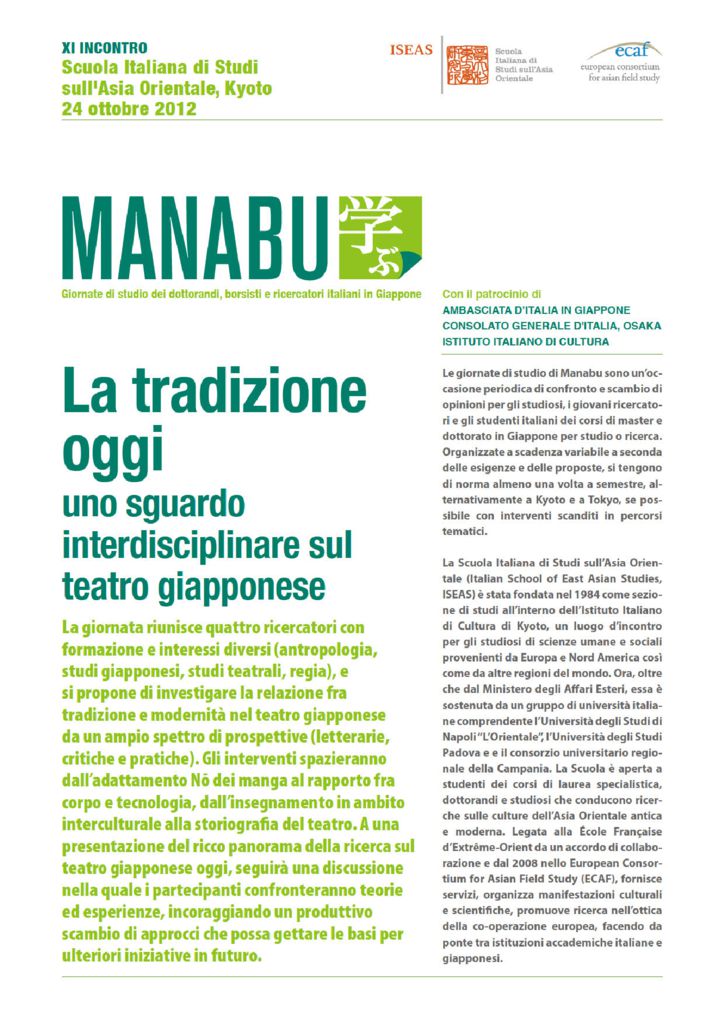
Manabu XI
La tradizione oggi: uno sguardo interdisciplinare sul teatro giapponese
24 ottobre 2012
Scuola Italiana di Studi sull’Asia Orientale, Kyoto
Manabu
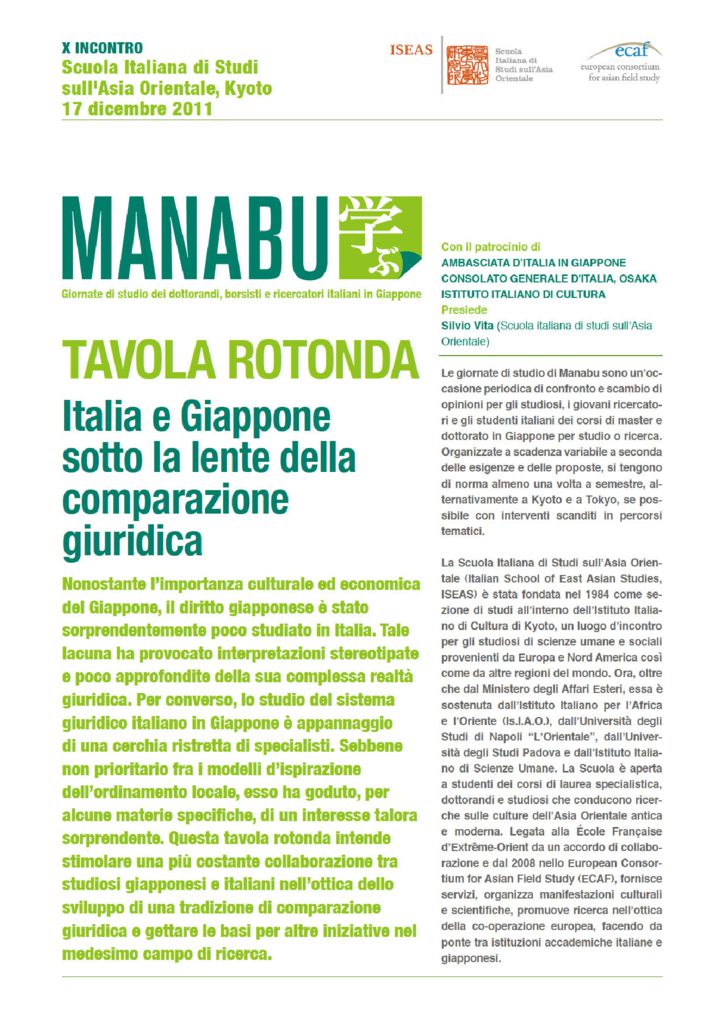
Manabu X
TAVOLA ROTONDA Italia e Giappone sotto la lente della comparazione giuridica
17 dicembre 2011
Scuola Italiana di Studi sull’Asia Orientale, Kyoto
Manabu
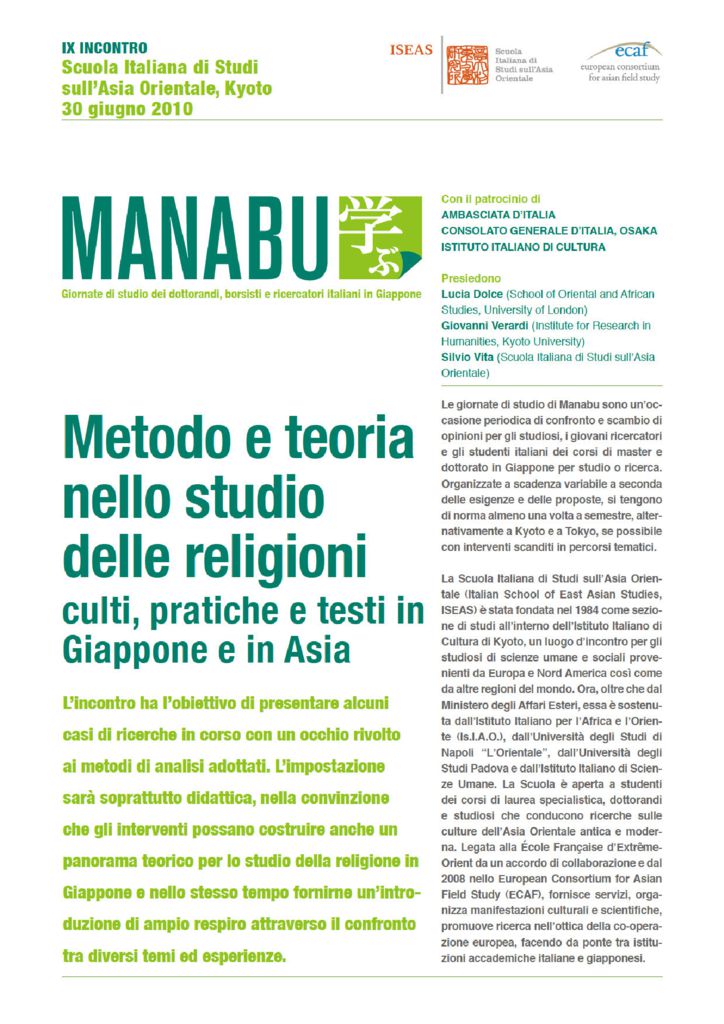
Manabu IX
Metodo e teoria nello studio delle religioni: culti, pratiche e testi in Giappone e in Asia
30 giugno 2010
Scuola Italiana di Studi sull’Asia Orientale, Kyoto
Manabu
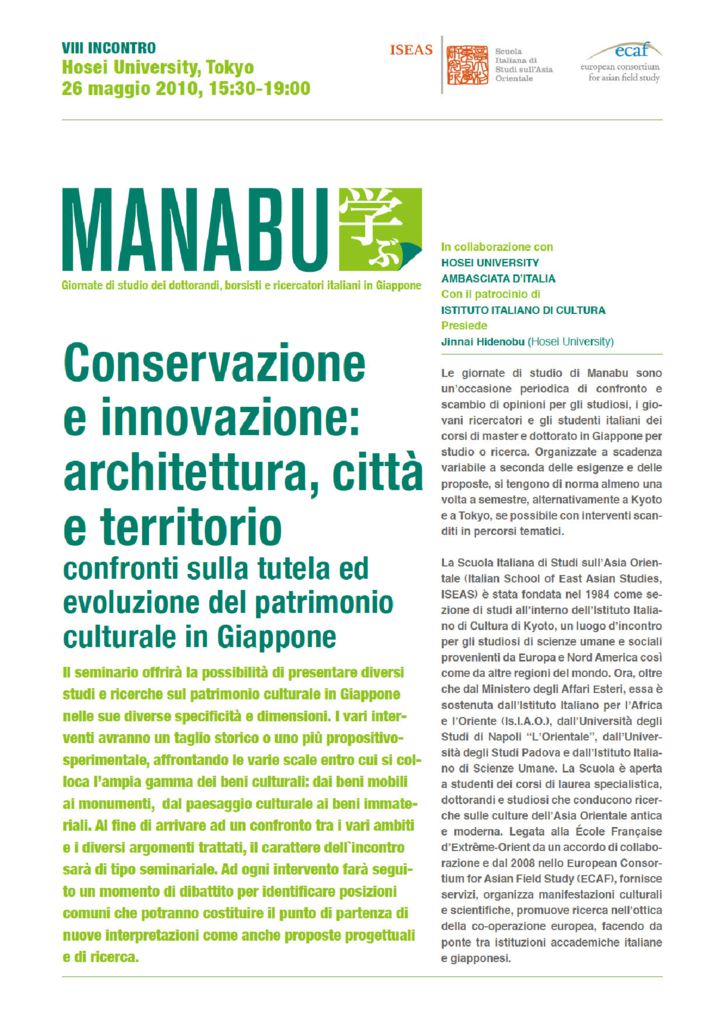
Manabu VIII
Conservazione e innovazione: architettura, città e territorio / confronti sulla tutela ed evoluzione del patrimonio culturale in Giappone
26 maggio 2010
Manabu
Manabu XII
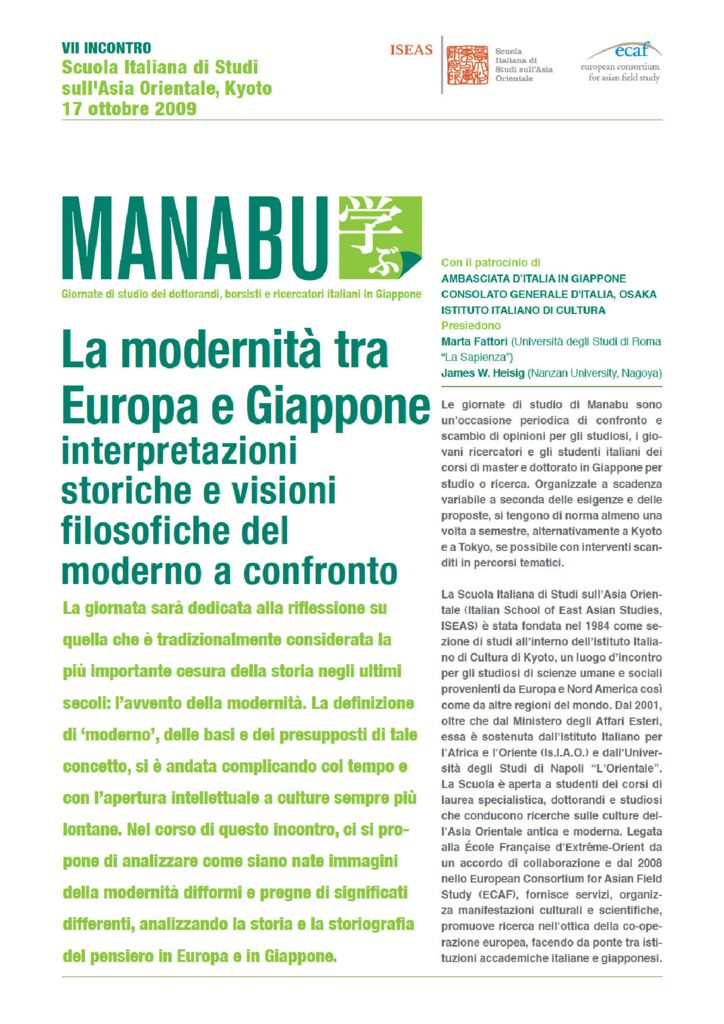
La modernità tra Europa e Giappone: interpretazioni storiche e visioni filosofiche del moderno a confronto
17 ottobre 2009
Scuola Italiana di Studi sull’Asia Orientale, Kyoto
Manabu
Manabu VI
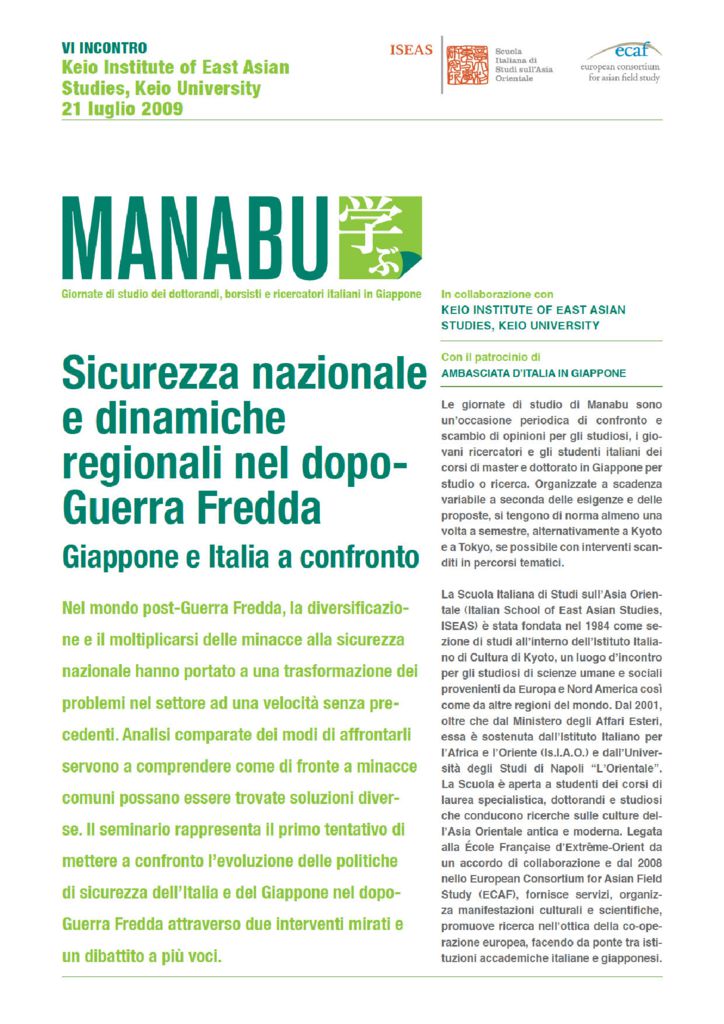
Sicurezza nazionale e dinamiche regionali nel dopo-Guerra Fredda
21 luglio 2009
Keio Institute of East Asian Studies, Keio University, Tokyo