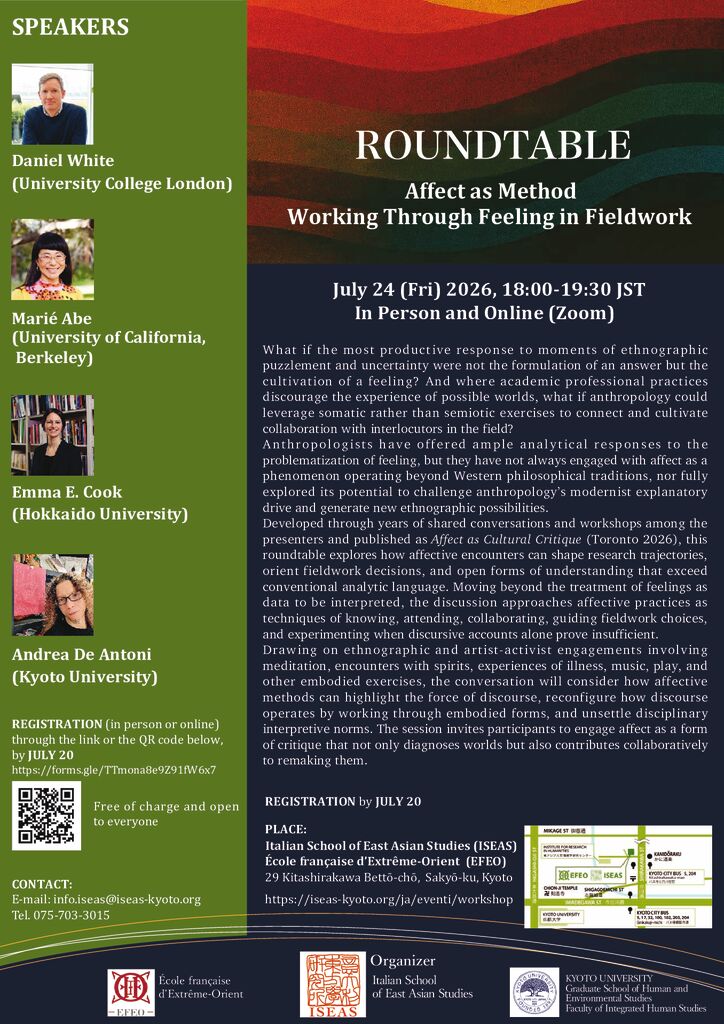
Speakers:
Daniel White (University College London)
Marié Abe (University of California, Berkeley)
Emma Cook (Hokkaido University)
Andrea De Antoni (Kyoto University)
What if the most productive response to moments of ethnographic puzzlement and uncertainty were not the formulation of an answer but the cultivation of a feeling? And where academic professional practices discourage the experience of possible worlds, what if anthropology could leverage somatic rather than semiotic exercises to connect and cultivate collaboration with interlocutors in the field?
Anthropologists have offered ample analytical responses to the problematization of feeling, but they have not always engaged with affect as a phenomenon operating beyond Western philosophical traditions, nor fully explored its potential to challenge anthropology’s modernist explanatory drive and generate new ethnographic possibilities.
Developed through years of shared conversations and workshops among the presenters and published as Affect as Cultural Critique (Toronto 2026), this roundtable explores how affective encounters can shape research trajectories, orient fieldwork decisions, and open forms of understanding that exceed conventional analytic language. Moving beyond the treatment of feelings as data to be interpreted, the discussion approaches affective practices as techniques of knowing, attending, collaborating, guiding fieldwork choices, and experimenting when discursive accounts alone prove insufficient.
Drawing on ethnographic and artist-activist engagements involving meditation, encounters with spirits, experiences of illness, music, play, and other embodied exercises, the conversation will consider how affective methods can highlight the force of discourse, reconfigure how discourse operates by working through embodied forms, and unsettle disciplinary interpretive norms. The session invites participants to engage affect as a form of critique that not only diagnoses worlds but also contributes collaboratively to remaking them.
This hybrid roundtable will be held on site and via Zoom.
Registration required in advance from here by July 20.