Kyoto Lectures
Rule of (Cosmological) Law
The Rhetoric of Authority in Japan’s Medieval Mirrors
Erin L. Brightwell
April 18th, 2019 18:00
Italian School of East Asian Studies
Kyoto Lectures
The Japanese Uses of European Renaissance
Regeneration and Reconstruction in the Modern Period
Francesco Campagnola
March 7th, 2019 18:00
Italian School of East Asian Studies
Kyoto Lectures
Counter-Reformation Heroes in the Making
The Beatification of the 26 Martyrs of Nagasaki
Hitomi Omata Rappo
February 14th, 2019 18:00
Italian School of East Asian Studies
Kyoto Lectures
In a State of Excess
"Reckless Gathering" and the Meiji Cultivation of Ago Bay
Kjell Ericson
January 15th, 2019 18:00
École Francaise d’Extrême-Orient
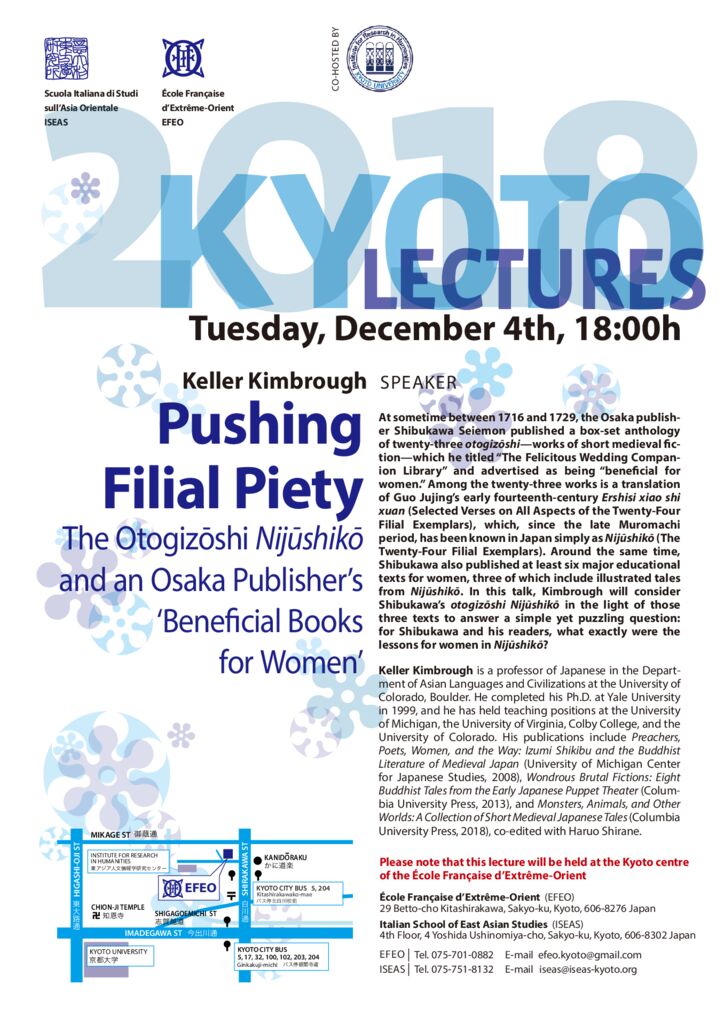
Kyoto Lectures
Pushing Filial Piety
The Otogizoshi Nijushiko and an Osaka Publisher’s ‘Benecial Books for Women’
Keller Kimbrough
December 4th, 2018 18:00
École française d'Extrême-Orient
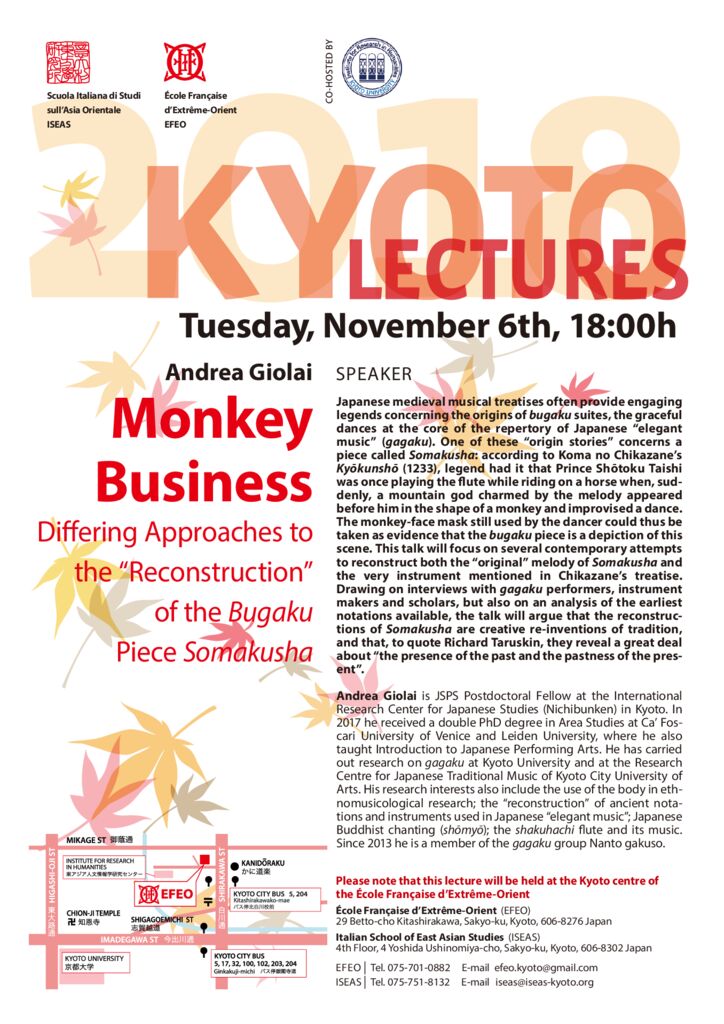
Kyoto Lectures
Monkey Business
Differing Approaches to the “Reconstruction” of the Bugaku Piece Somakusha
Andrea Giolai
November 6th, 2018 18:00
École française d'Extrême-Orient
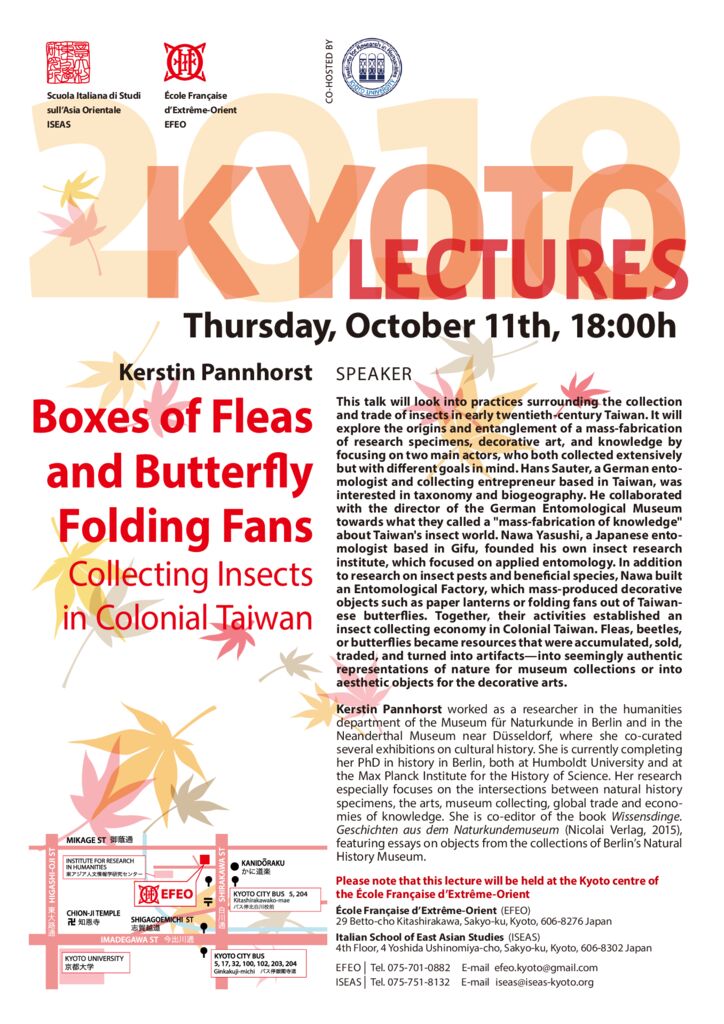
Kyoto Lectures
Boxes of Fleas and Butter
Collecting Insects in Colonial Taiwan
Kerstin Pannhorst
October 11th, 2018 18:00
École française d'Extrême-Orient
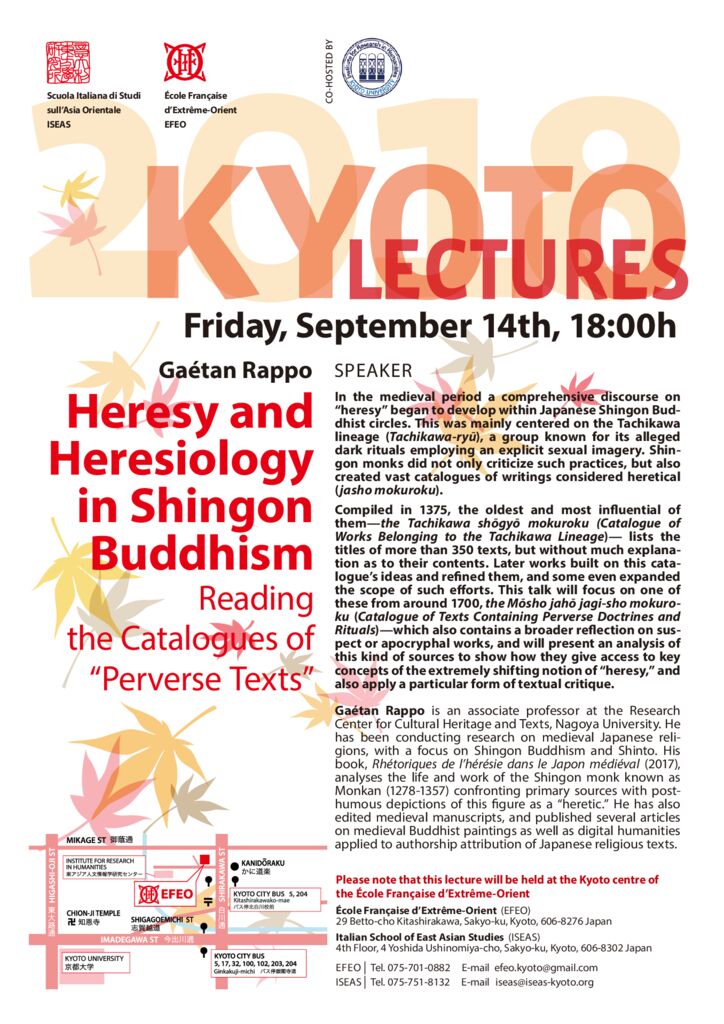
Kyoto Lectures
Heresy and Heresiology in Shingon Buddhism
Reading the Catalogues of “Perverse Texts”
Gaétan Rappo
September 14th, 2018 18:00
École française d'Extrême-Orient
Kyoto Lectures
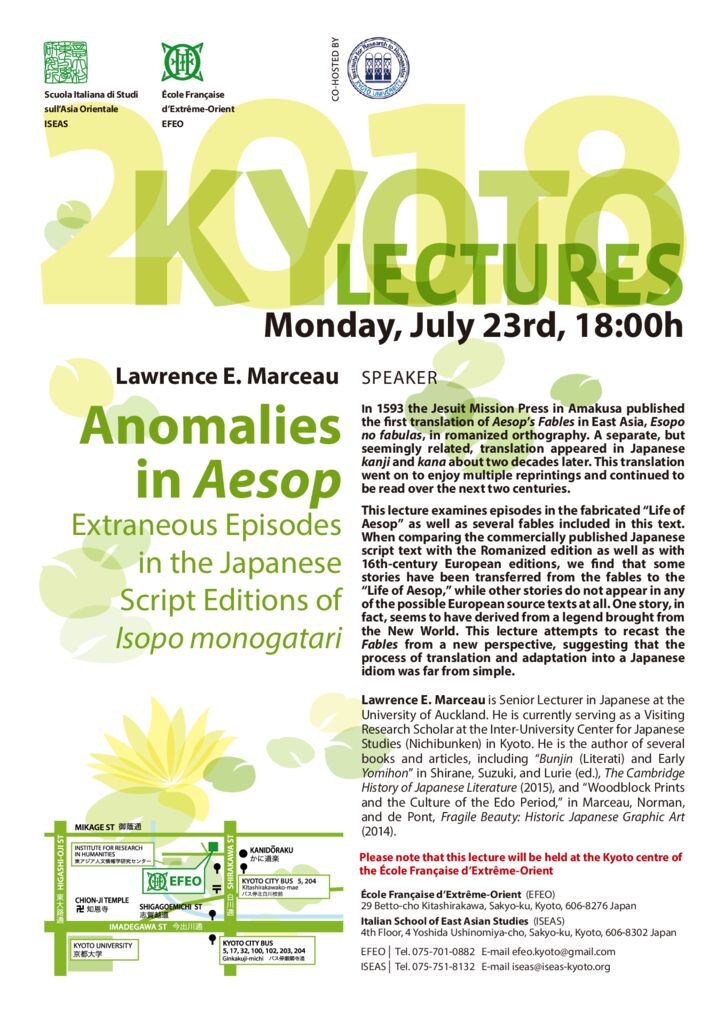
Anomalies in Aesop
Extraneous Episodes in the Japanese Script Editions of Isopo monogatari
Lawrence E. Marceau
23 luglio 2018 18:00
École française d'Extrême-Orient
In 1593 the Jesuit Mission Press in Amakusa published the first translation of Aesop’s Fables in East Asia, Esopo no fabulas, in romanized orthography. A separate, but seemingly related, translation appeared in Japanese kanji and kana about two decades later. This translation went on to enjoy multiple reprintings and continued to be read over the next two centuries.
This lecture examines episodes in the fabricated “Life of Aesop” as well as several fables included in this text. When comparing the commercially published Japanese script text with the Romanized edition as well as with 16th-century European editions, we find that some stories have been transferred from the fables to the “Life of Aesop,” while other stories do not appear in any of the possible European source texts at all. One story, in fact, seems to have derived from a legend brought from the New World. This lecture attempts to recast the Fables from a new perspective, suggesting that the process of translation and adaptation into a Japanese idiom was far from simple.
Lawrence E. Marceau is Senior Lecturer in Japanese at the University of Auckland. He is currently serving as a Visiting Research Scholar at the Inter-University Center for Japanese Studies (Nichibunken) in Kyoto. He is the author of several books and articles, including recently “Bunjin (Literati) and Early Yomihon” in Shirane, Suzuki, and Lurie (ed.), The Cambridge History of Japanese Literature (2015), and “Woodblock Prints and the Culture of the Edo Period,” in Marceau, Norman, and de Pont, Fragile Beauty: Historic Japanese Graphic Art (2014).
Kyoto Lectures
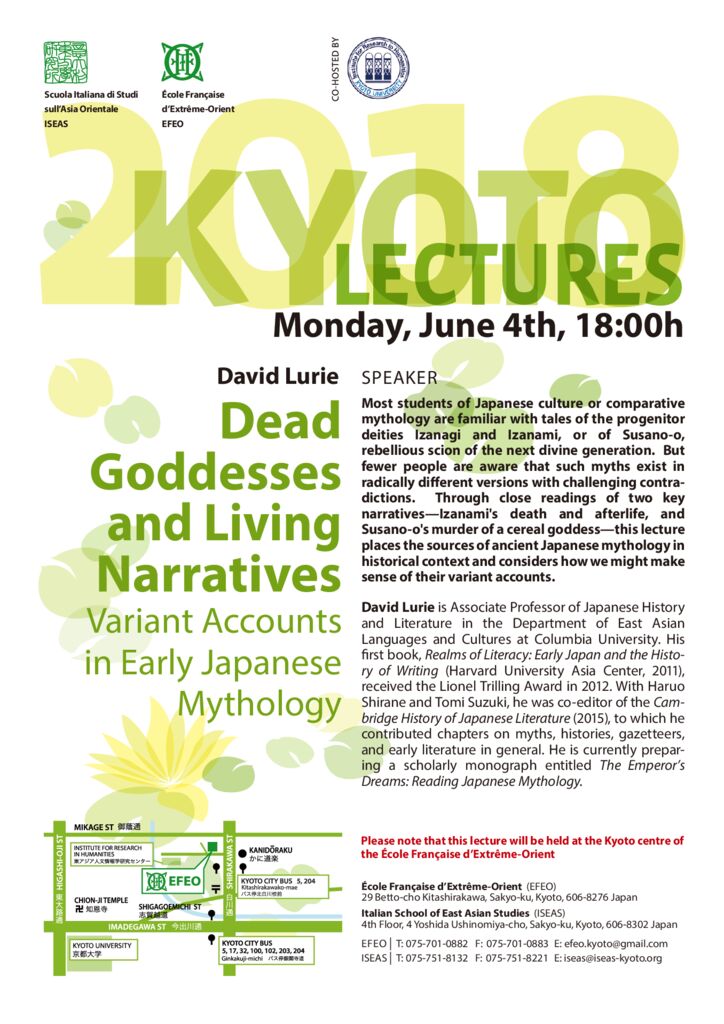
Dead Goddesses and Living Narratives
Variant Accounts in Early Japanese Mythology
David Lurie
4 giugno 2018 18:00
École française d'Extrême-Orient
Most students of Japanese culture or comparative mythology are familiar with tales of the progenitor deities Izanagi and Izanami, or of Susano-o, rebellious scion of the next divine generation. But fewer people are aware that such myths exist in radically different versions with challenging contradictions. Through close readings of two key narratives—Izanami’s death and afterlife, and Susano-o’s murder of a cereal goddess—this lecture places the sources of ancient Japanese mythology in historical context and considers how we might make sense of their variant accounts.
David Lurie is Associate Professor of Japanese History and Literature in the Department of East Asian Languages and Cultures at Columbia University. His first book, Realms of Literacy: Early Japan and the History of Writing (Harvard University Asia Center, 2011), received the Lionel Trilling Award in 2012. With Haruo Shirane and Tomi Suzuki, he was co-editor of the Cambridge History of Japanese Literature (2015), to which he contributed chapters on myths, histories, gazetteers, and early literature in general. He is currently preparing a scholarly monograph entitled The Emperor’s Dreams: Reading Japanese Mythology.